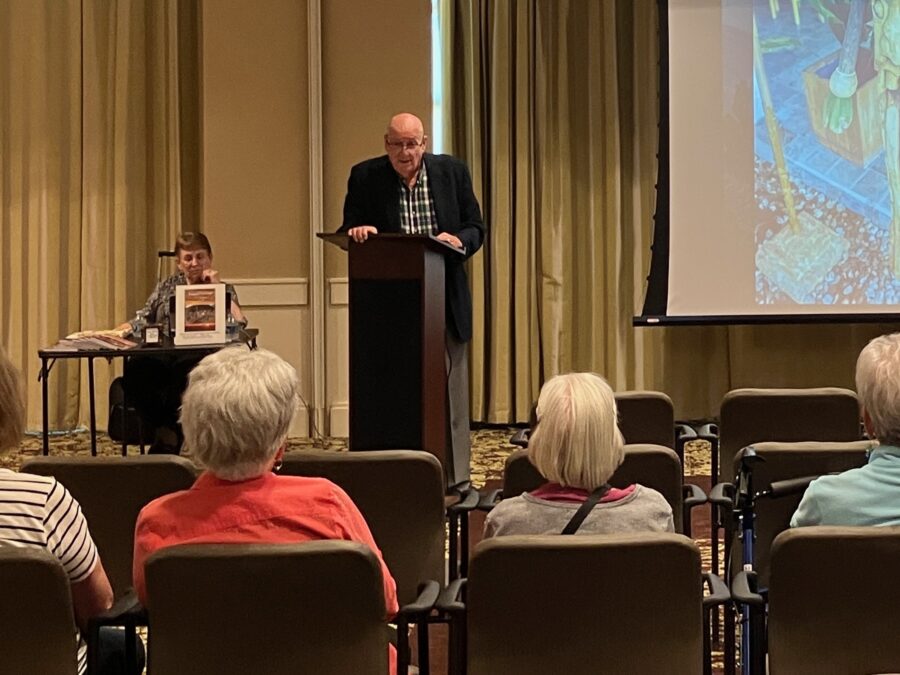
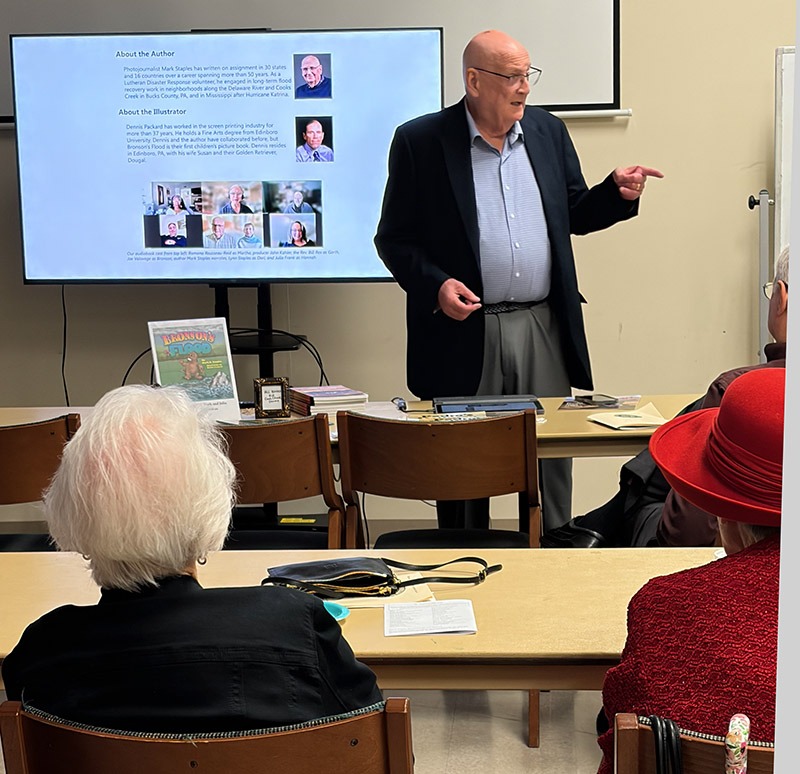
I was invited Sunday Oct. 25 to do a tag team presentation with Julia Frank, who has both regional and national responsibilities when it comes to responding to natural disasters. Julia works for Lutheran Congregational Services in coordinating Lutheran Disaster Response efforts in Pennsylvania. The occasion was such a gift to me.
Julia Frank uses a chart to show the impact of climate change on natural disaster frequency (photo by Lynn Staples)
Julia’s been doing this outreach work with both volunteers and storm survivors for about 25 years and gave evidence in her part of the presentation of how climate change is impacting her work.
For my part, I was presenting about Bronson’s Flood, a children’s book in which Bronson Beaver discovers his gifts and abilities to work with his neighbors in the Wide Woods to stave off a flash flood threat in the midst of a terrible rainstorm.
Because it was Reformation Sunday in our Lutheran tradition, the occasion had even deeper meaning for me than it otherwise might have.
I only came to the Lutheran tradition through dating and then becoming married to my dear spouse of 59 years, Lynn Roberts Staples, originally from Allentown, PA.
After Lynn and I met, her parents regularly invited me into their home, far from my home town of Melrose, MA. I welcomed the opportunity to have a special home to visit near the campus of Lafayette College, where I was studying for a BA.
There was only one catch, a weekend requirement issued directly by her Dad, Allen Roberts, “You are welcome to stay with us, but you have to accompany us to church when you visit.”
Mark makes a point about Martin Luther’s Doctrine (photo by Lynn Staples)
And so, over the years, I graduated into the Lutheran tradition from my Congregational upbringing.
Assimilating into the Lutheran tradition changed my life. Over my career I became an editor for my Lutheran Church in America’s national periodical. I served on four congregation councils. Life-changing also was the period of 18 years where I worked as director of communications at The Lutheran Theological Seminary at Philadelphia (now United Lutheran Seminary after a merger with Gettysburg Seminary) and later as director of the school’s Faith and Life Institute, through which laity could earn certificates via what we called life-long learning.
My work at the seminary repeatedly introduced me to the influence of Reformer Martin Luther on our tradition, so ably expressed by Dr. Timothy Wengert, who taught the Lutheran Confessions. Five-hundred years ago Luther never wanted to establish a Lutheran Church, rather he wanted to reform the Roman Catholic tradition by steering it away from any notion that believers had to earn God’s love through their actions. Luther wrote that when Jesus died on the cross, he took upon himself the burden of our sinful behavior. We no longer have to worry about that. Just go and do for your neighbor what you can.
“God doesn’t need your good works,” Luther once wrote. “But your neighbor does.”
And so, on Sunday I reminded my listeners of Luther’s doctrine of vocation. I wrote about it some years ago in a cover piece for our denomination’s national magazine during a time when many folks were struggling with layoffs and wondering what to do. What some folks were discovering was that a layoff was opening up a new and valuable vocational chapter in their lives.
Before the Reformation, the only “sacred” vocations were thought to be those of priests, nuns and monks.
Luther contended, however, that the legitimate vocations of ordinary life – farming, working as a cobbler, digging ditches, being a mother, being a ruler, as well as a priest – were all vocations with equal spiritual value. He noted all forms of legitimate work were ways of serving one’s neighbors in efforts to achieve common good. All were of equal merit.
These ideas of Luther’s were controversial 500 years ago, and I daresay may well remain so today.
Many of us discredit our vocations as not being worthy enough, or not being as worthy as other vocations. Or we elevate the notoriety of others for their “special” achievements, setting them aside in our minds for remarkable recognition, surpassing any recognition we believe we could ever hope to achieve or deserve.
Luther’s writing produced the idea of leveling the stations of the culture of his day. And it was upsetting for some.
I like to tell children when I read Bronson’s Flood to them that they are each a crucial, special piece in God’s humongous global people puzzle. God needs all the pieces in place, or else the puzzle is incomplete. I urge them to work with the adults who care for them to discover their unique gifts and figure out how to best use those gifts in service to themselves and others the way Bronson figured out how to use his gifts in my book, Bronson’s Flood. And the way Julia Frank through her vital work has made such a difference over the past 25 years, making use of her remarkable leadership skills.
Such efforts by today’s youth will honor Reformer Martin Luther’s legacy on vocation so inventively expressed in writing that remains as valuable today as ever.