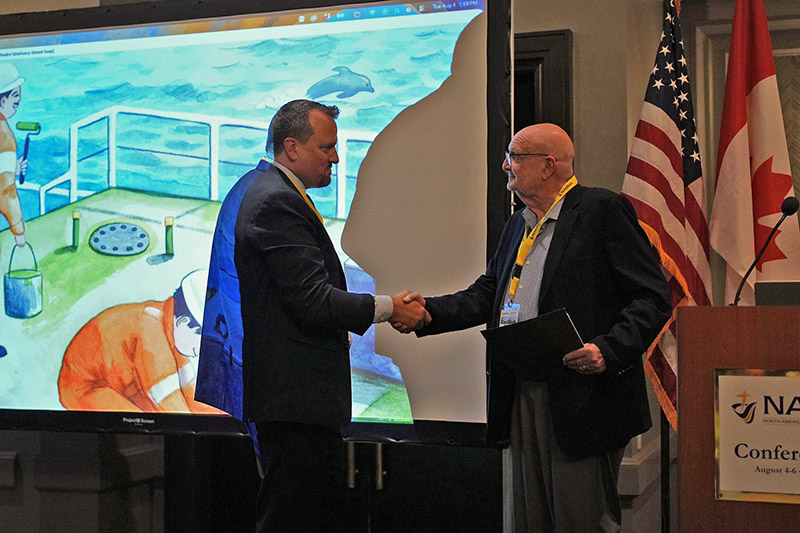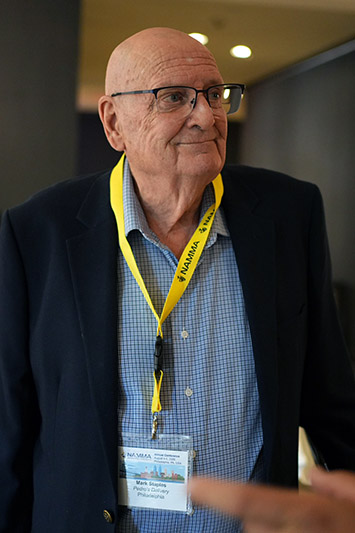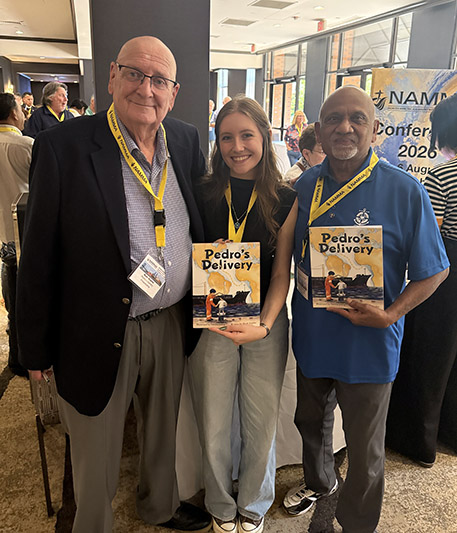
A note from Mark:

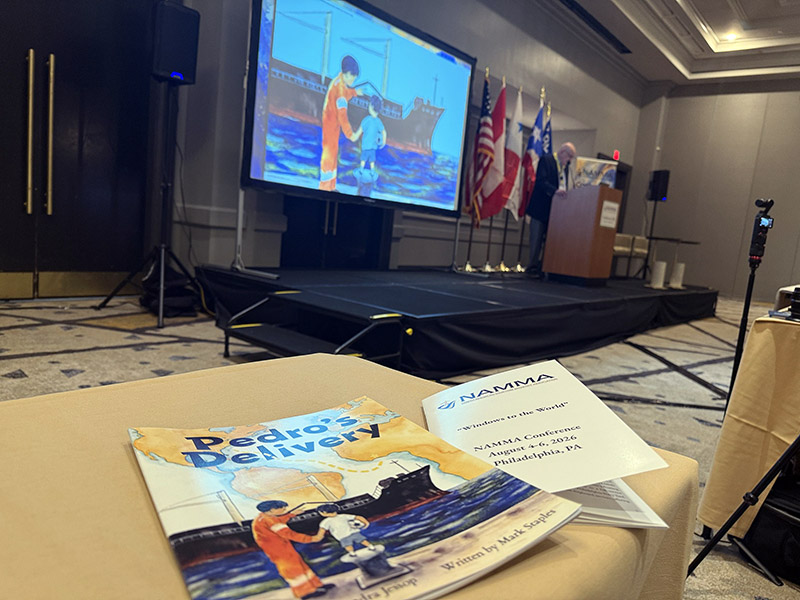
I wrote Pedro’s Delivery to honor seafarers who toil so nobly across the globe to get us so many of the goods we buy and depend upon. Folks love the story!
A note from Mark:

I wrote Pedro’s Delivery to honor seafarers who toil so nobly across the globe to get us so many of the goods we buy and depend upon. Folks love the story!
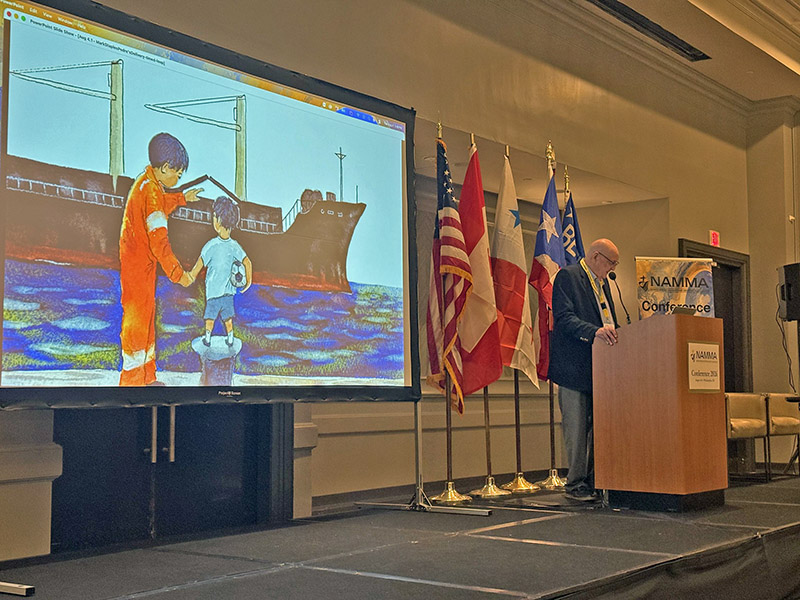
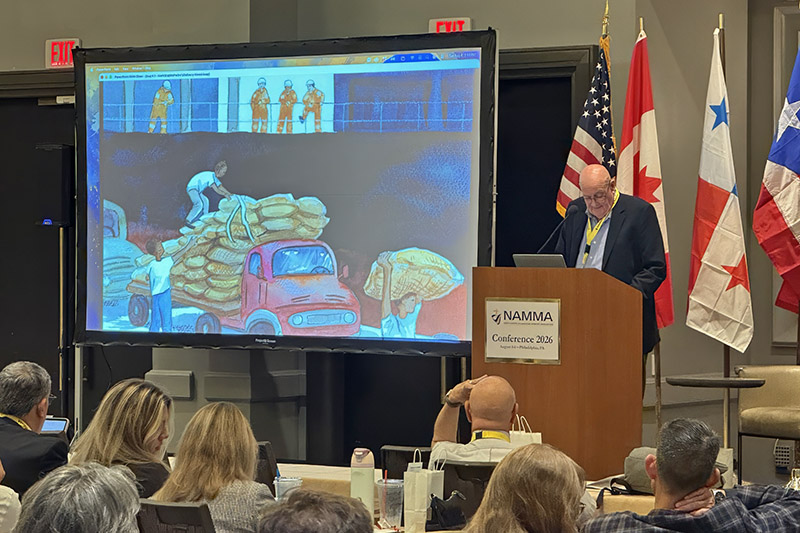
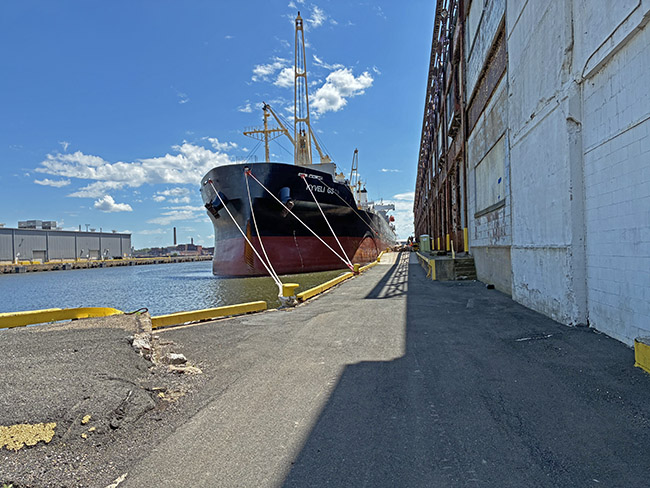
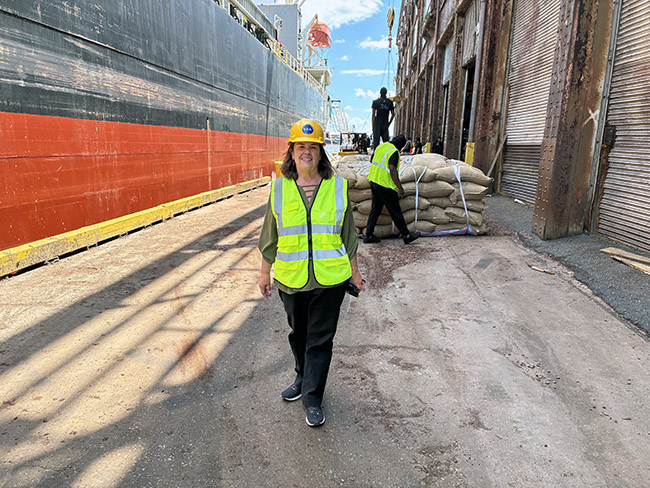
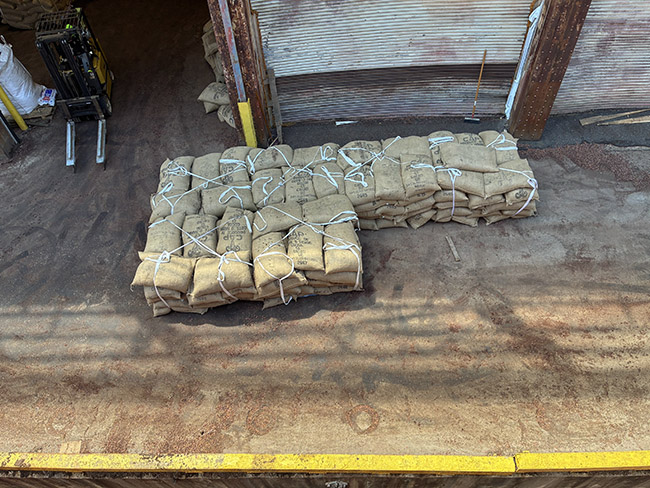
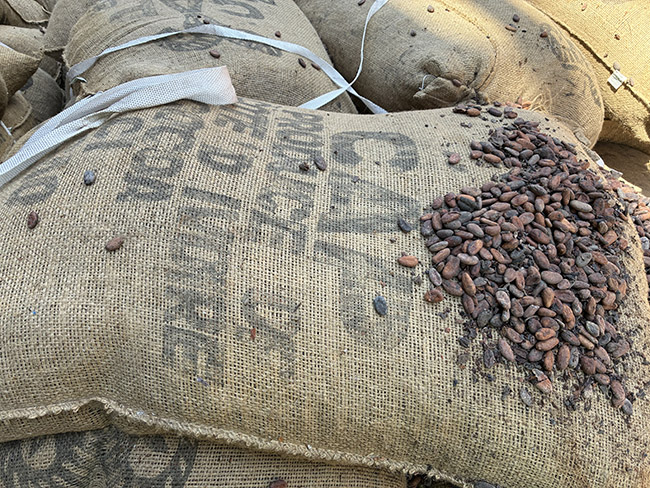
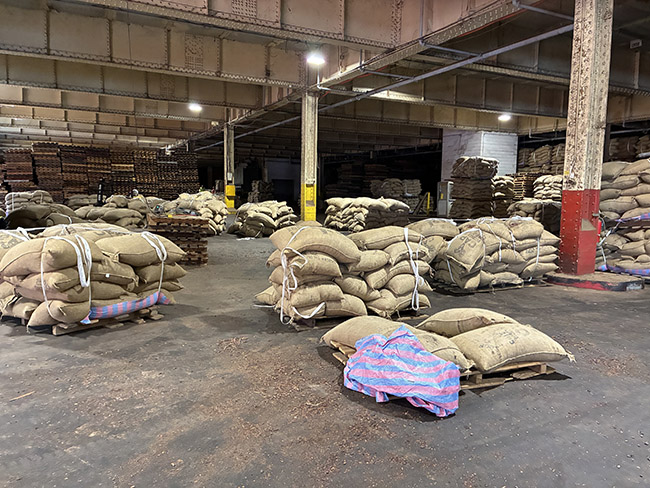
Scenes on Pier 84, Port of Philadelphia. The huge cargo ship, the Kyveli GS, was at dockside.
I’ve written elsewhere about my pending early reader children’s book Pedro’s Delivery, a fictional story based on fact about a Filipino seafarer who escorts cocoa beans from the Ivory Coast to Philadelphia and the difference mariners from often faraway places make in our daily lives.
At age 81 my life has had many blessed chapters, twists and subplots. This blog will celebrate the ones that led to this new book, which comes out in July. Maybe you have had similar unfolding stories. I believe God has breathed life into each subplot.
About 25 years ago I worked with other Lutherans on a long-term flood recovery escapade to help mostly older residents along the banks of the Delaware River recover from the ravages of two tropical storms. That work involved me with seminarians from what was then known as The Lutheran Theological Seminary at Philadelphia (now part of United Lutheran Seminary), as well as volunteers from Trinity Lutheran Church in Lansdale, PA. Volunteering several years along the Delaware was in itself life changing. My wife, Lynn and I subsequently helped out in the aftermath of Katrina in Mississippi.
While working in Bucks County I met another volunteer, the Rev. William Rex, who was pastoring a Lutheran church in nearby Ferndale. Eventually, Bill invited me to serve with him as a shipboard visitor extending hospitality to cargo ship seafarers visiting the Port of Philadelphia.
One ministry leads to another. I became a visitor with Homeland Security credentials affording me access to highly secure terminals in the Port of Philadelphia. That service was as an ambassador for Seamen’s Church Institute of Philadelphia and South Jersey (SCI) for 10 years.
Memories gleaned from relating to thousands of seafarers on hundreds of ships led me to write Pedro’s story. I wanted early readers to know something of how commodities get to their store shelves. I wanted them to know about the seafaring professionals who sacrifice so much to “deliver” for them.
I showed my manuscript to Helene Pierson, the CEO for SCI, a couple of years ago long after I had “retired” from climbing gangways on so many ships, sometimes writing stories about my experiences for SCI when Father Jim Von Dreele was the SCI leader. After reading it to a grandchild, Helene was enthusiastic about the “face” the story would give to many who know little, if anything about the origins of commodities we take for granted when we shop.
She has been a vigorous supporter, helping me with author photos aboard ship in Gloucester City, NJ, early in 2026 and introducing me to Jeff Wheeler, the man who oversees the importing of cocoa beans from West Africa to the Port of Philadelphia, and the distributing from there of bags of beans as far away as Illinois and Wisconsin. In 2025 the Port of Philadelphia imported 5 million bags of cocoa beans, more than received by any other port in the U.S. Jeff himself is a remarkable story. He began as a longshoreman helping to load bags of cocoa beans on railroad cars in the Port. Today he is the chief executive of Dependable Distribution Services, Inc. in Pennsauken, NJ. Jeff has also become an advocate for Pedro’s story. “Many people don’t understand much about the people who work in international trade and what goes on behind the scenes in places like our port,” he says. “This book will really put a face on that work.”
A couple of other twists remain to relate about this Pedro journey.
I had an electronic exchange on Alignable, a sprawling electronic network for entrepreneurs, with Yvonne Kathryn Caputo, an author of adult books published with Ingenium Books of Toronto. Yvonne suggested I submit Pedro’s manuscript to that publishing house. Ingenium acquired the rights to publish the book. Unfortunately, Ingenium closed while the book was in process. Happily, Pedro was picked up by Pink Umbrella Books of San Clemente, CA. Ingenium had hired Pink Umbrella’s owner, Adrienne Quintana, to work with me and illustrator Sandra Jessop to develop the book. Thanks to Yvonne’s suggestion, Pedro’s Delivery will soon come to pass! I am deeply grateful to Adrienne and Sandra for all their hard work!
And special credit goes to John Kahler of Coatesville, PA, my long-time friend, technical specialist, photographer and publicist. He plays a major role in bringing my work to life. John is truly a wizard!
The final special twist in this Pedro Journey belongs to Lynn Roberts Staples, my spouse of nearly 59 years. Without her encouragement and support none of this happens.
Pedro’s main lesson is a simple global perspective I hope children will take to heart as they read. We need each other.
My book, Pedro’s Delivery, set for publication by Pink Umbrella Books of San Clemente, CA, in July, tells the story of a Filipino seafarer who escorts bags of cocoa beans from the Ivory Coast in West Africa to the Port of Philadelphia in the U.S.
The book puts a face for young readers on those who sacrifice to bring commodities that eventually land on our store shelves. Who doesn’t enjoy candy or a mug of hot chocolate on a cold winter’s day? A work of fiction, the story is based on my 10 years of experience relating to seafarers from myriad backgrounds while working as a volunteer shipboard visitor, furnishing hospitality to crewmembers on behalf of Seamen’s Church Institute of Philadelphia and South Jersey.
Seafarers endure weather hardships and long periods of time away from home as linchpins in global trade exchanges that improve our lives. They visit some 360 ports in the U.S. alone along three coasts, the Mississippi River and the Great Lakes. Some 1.9 million seafarers serve on cargo ships globally.
Nowhere are the challenges facing cargo ship crews more evident these days than those aboard ships near Iran’s Strait of Hormuz. Normally 100 ships or more pass through the Strait daily bearing cargos like petroleum, coal, grains and fertilizer. In the current spring planting season, farmers depend on affordable fertilizer, much of which traverses the Strait, to generate the crops they raise. The current state of the Strait, however, is that traffic is severely restricted, according to news reports. And the degree of restriction is a day-to-day issue as Iran uses the closure as a bargaining tool to negotiate an end to the war. The Strait’s restrictions have upended much of the world’s economy.
As many as 2,000 cargo ships bearing 20,000 seafarers were recently “stuck” near the Strait. Recent reports, during a cease fire, indicated conditions were somewhat calmer for crews than was the case at the recent height of the conflict when seafarers could view overhead drones and hear the impact of heavy bombing, depending on their location. During the best days of the ceasefire open airports made it easier to transfer crew members as contracts for their work begin or end. Resumption of some hostilities have threatened to disrupt the state of relative calm for seafarers. A cargo tanker, reportedly carrying oil from Iran and allegedly struck from the air by U.S. forces, took the lives of three seafarers from India in June, according to a New York Times report. They were the first seafarer casualties from the war.
Provisions aboard ship last four to six weeks. Delivering needed goods, however, is more costly to ships at anchor than when a ship is at berth in a port, according to Jason Zuidema, the chief executive for the North American Maritime Ministry Association (NAMMA), who is among many tracking the war’s impact on seafarers. Such costs will likely sooner or later impact consumer pocketbooks, he suspects.
Medical emergencies are always a challenge when ships are at sea. For vessels stranded near the Strait such emergencies are much harder to deal with than when a ship is in port.
Large shipping concerns are doing what they can to support their seafarer employees, according to reports. Technology aboard ships makes it easier for crewmembers to be in touch with loved ones. Some concerns offer hardship pay in the face of crews’ uncertain predicaments. But, those amenities do not ease the stress of wondering whether seafarers could soon once more be witnesses to wartime hostilities that could place them in peril.

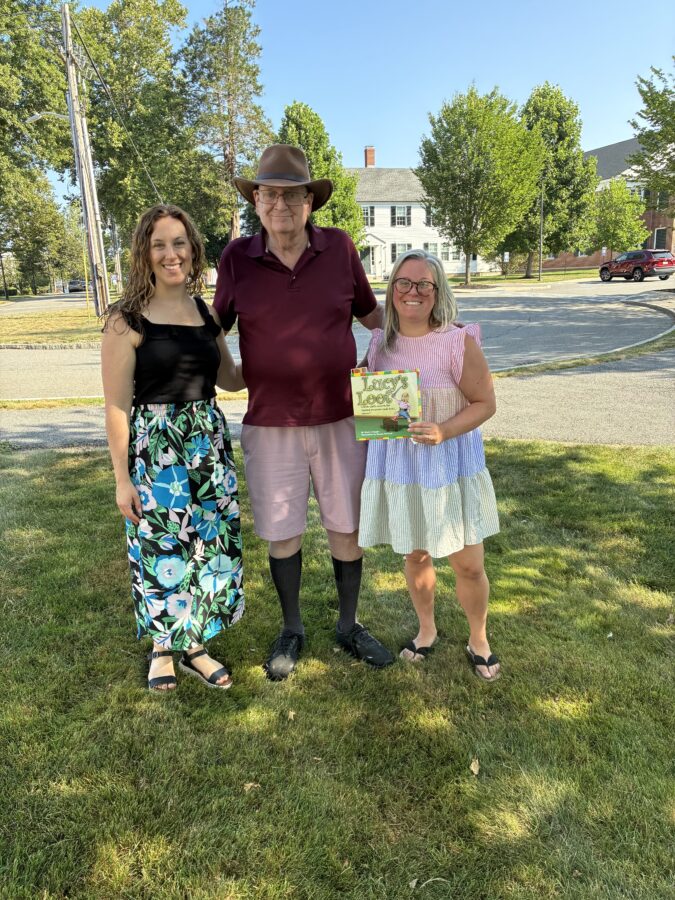
Staffers from Lawrence Academy at Groton (MA) welcome Mark during an August campus visit. From left: Sarah Chadwick, Mark, class of ‘63, and Leigh Korpal, holding “Lucy’s Loot,” Mark’s latest children’s picture book.

A once-missing earring can be “buried” treasure.
The tale behind this latest picture book is based on fact.
Our granddaughter, Lucy McGettigan, 8-years-old at the time of the story, often visited us on weekends.
The memories of those times remain alive and precious to me.
In the case of the story in this book, I had in mind a chore that needed to be accomplished – vacuuming the living room, including tipping the sofa back to clean beneath the furniture. It hadn’t been done for months.
Because of the way the furniture worked, a recliner at each end with spaces open to the floor next to each side of the middle seat cushion, I had a hunch there might be “stuff” on the floor that had fallen over time from the pockets of folks who sat there. But I really didn’t know what.
As I prepared breakfast, I concocted a scheme. Might we turn a household chore into a search for unknown “buried” treasure? An adventure?
As the picture book notes, I ran the idea by Lucy. She imagined a typically exotic activity at first.
When I pointed out the actual nature of the chore/adventure to Lucy she was skeptical and disappointed at first, but she trusted me. In the book, she then used her imagination to embellish the chore into an adventure featuring costumes. This part of the book is beyond what really happened that day and was the suggestion of my children’s book editor, Kellie Hultgren of Minneapolis. But the costume idea would not have been unusual for the imaginative granddaughter that I love. What is fact is that Lucy did latch onto the idea originally because of many good experiences we had shared before.
No one was more surprised than me that “treasure” was indeed to be found on the dust-mite-filled hardwood floor beneath the sofa. Of course, a few of the items were old and unsavory. But some of the findings had value.
Is there significance to a story like this beyond its serving as simply a fun-filled memory? The largely spontaneous activity featured unanticipated surprise. It became something of an educational exchange opportunity for us both at the time too. Namely, it is possible to find “buried” treasure close to home in an unusual, sometimes forgotten place. Have you ever found an earring that’s been missing when you went to vacuum the floor a day or two later? Have you ever known the joy that comes with such a discovery?
We’re turning Lucy’s Loot into an audiobook with our voices to provide memories for family members who come after us.
Lucy and her grandparents have shared many memories over the years. She is now 20 and an amazing young woman.
If you recall an episode like this with a loved one such as a grandchild or child, please leave a comment here. In a few sentences. Maybe the memory might become a book for you!
Most of you know about my background in photojournalism explained elsewhere on this site.
I remain a news junkie, but when the daily reports about divisiveness, featuring strident criticisms of diversity equity and inclusion (DEI) abound too disagreeably for me, I turn to music. These days that happens often.
I tried to celebrate those DEI qualities in my book Neighbors Revisited anyway. The book, which you can obtain through this website, is the best way I’ve had as a writer to disparage critics of DEI and celebrate the values of people who don’t look like me and what they have to offer to our world. Without those folks I’ve met along the way in my reporting and photography, the world would be a much lesser place. Back to music. I enjoy jazz and classical music. Sometimes I find humor in it. An imaginative jazz pianist and lyricist, Mose Allison, once wrote a song with the title, “I don’t worry about anything, because I know nothing is going to be alright.” The song gives me a laugh, gallows-like.
Mostly I watch a lot of classical performances on YouTube. A favorite symphony of mine is Number One by Johannes Brahms. A favorite version involves the Radio Orchestra of Frankfurt under the direction of Andres Orozco Estrada, a native of Medellin, Colombia, and now a celebrated violinist and musical director with energy and spirit that abounds.
Many aspects of this symphony performed so inspirationally move me deeply. First, and those of you familiar with it already know about this, there is the moment in the fourth movement when, musically, the clouds part and the sun peeks through in the form of a French horn solo and the flute and other instruments that unforgettably follow. I know when that groundbreaking solo is coming, but, still, it gets me every time, and I weep through it. It tells me musically that truly everything is going to be OK (unlike the Mose Allison lyric the jazz pianist does so tongue in cheek). And I take deep heart in the gift of that sound so eloquent. It speaks profoundly to the deepest part of my God-given soul.
Then there are the performers themselves. I’ve heard and seen them now in many performances, one being Igor Stravinsky’s “The Rite of Spring.” It is an inclusive group featuring in one performance a Black flautist, Filipino and other Asian violinists. They are so beautifully rehearsed, all pulling and working together the same way to give voice to a supremely gifted German composer. It is the essence of what I tried to capture in Neighbors Revisited, that when we celebrate each other despite our differences and blend our talents and ideas the world becomes a better place, sometimes only for a moment.
Toward the end of the Brahms Symphony the camera captures a fleeting glance and smile from the renowned Spanish-born flautist Clara Andrada toward the gifted Black flautist beside her, London, England-born Matthew J. Higham. The moment briefly acknowledges the musical journey they have shared. Wonderful.
Praise be to God for the gift of experiences like this. Music to my ears and beyond.
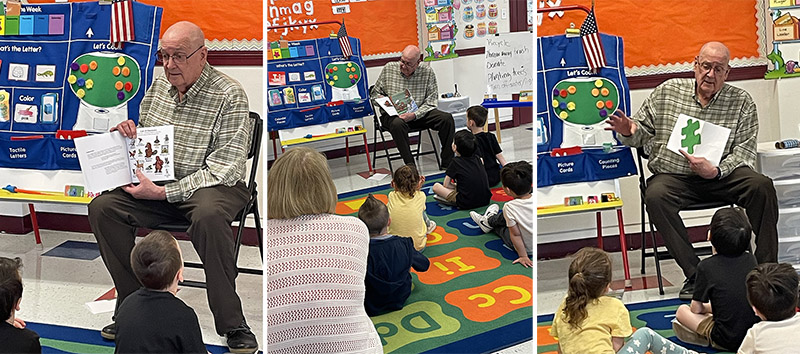
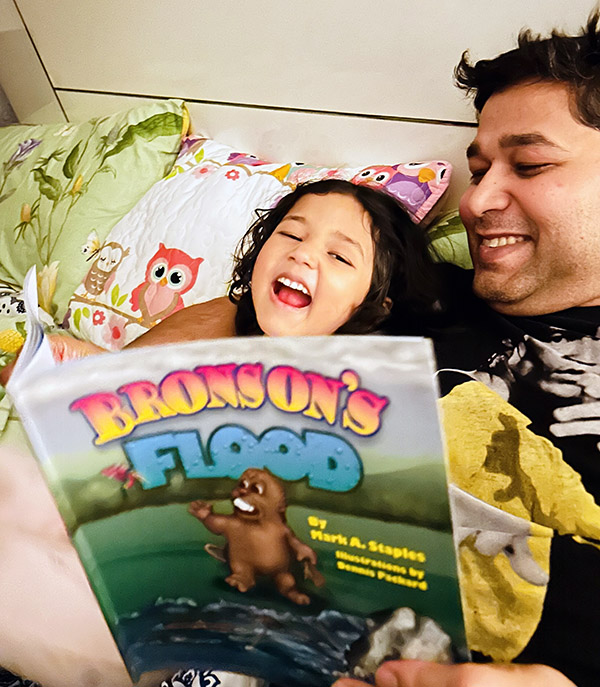
In April 2025 we captured images of the author sharing Bronson’s Flood with preschool children at Trinity Lutheran Church in Lansdale, PA and a Harleysville father reading Bronson to his daughter.

Mark had a great time reading “Bronson’s Flood” to 35 preschool children at Trinity Lutheran, Lansdale, April 22, 2025. (photos by Lynn Staples)

Abi Shaw and daughter, Mishika, of Harleysville, PA, enjoy reading “Bronson’s Flood” together. (Photo by Beauty Shaw)
My training as a journalist from the time I was in my twenties has taught me much about the limitations of human perspective. It has also taught me to examine viewpoints from all sides. That can be a challenge to do in such a polarized time. But I try. We are all human and have limits of knowledge and understanding, though. Reformer Martin Luther once taught that we all fall short of what God wants us to be.
I am grateful to have done research and reporting in a dozen countries and 30 U.S. states. I once worked 10 years as a volunteer shipboard visitor with Homeland Security credentials. During that time, I regularly went to dozens of highly secure terminals to greet seafarers from all over the world in the Port of Philadelphia. They and the hard work they did to bring us “stuff” we need really inspired me and helped my perspective. I am grateful to Seamen’s Church Institute of Philadelphia and South Jersey for that opportunity.

Dockworkers offload bags of cocoa beans from the cargo ship Lady Anthula in 2012.
I watched cargo ships offload materials like fertilizer, rock salt, asphalt, cocoa beans and Kia automobiles from all over the world. Philadelphia has been the largest importer of Chilean grapes. Ships bearing bananas for the Philadelphia region are commonplace. No wonder. My research indicates the U.S. is the largest consumer of bananas in the world. They are grown in the U.S., but the largest purveyors of the fruit are Honduras, Costa Rica, Guatemala, Ecuador and Mexico. Favorable climate seems to be a factor for their leadership. We consume everyone’s bananas! Cocoa beans, used to manufacture a variety of U.S. chocolate products, arrive in the Port of Philadelphia regularly. The largest grower of cocoa beans is the Ivory Coast in Africa. (Yes, some cocoa beans of high quality are made in Hawaii. And that is wonderful!) Why are most cocoa beans in the world grown in the Ivory Coast and Ghana and not in the U.S.? I’ve learned that’s because the climate in those countries highly favors such production.
Kia cars have a U.S. production site in Georgia. But the cars or parts included in them are manufactured in Pakistan, South Korea (company headquarters), China, India, Slovakia, Mexico, Japan and Vietnam.
Research has informed me that in the U.S. rock salt is mined in Livingston, NY, Texas and Michigan. In March of 2013, a ship I visited at the Riverside Terminal in the Port of Philadelphia brought us Rock Salt from Brazil. That ship was one of 13 to visit the Port, as I recall, because of the unusually harsh winter. Municipal trucks were lined up at Riverside to get the salt, offloaded through large funnels onto a conveyer belt to reach the trucks. Why was rock salt imported from a place like Brazil instead of being furnished out of Livingston or Grand Saline, TX? I learned it was likely because the demand imposed by a harsh winter outstripped the capacity of the U.S. to produce enough salt on its own. Price was possibly a factor as well.
The iPhone I carry in my pocket has components or manufacturing involving 63 countries including the U.S., according to Columnist Tom Friedman of the New York Times.
Why write about all this? 1.) My experience as a journalist and in visiting seafarers in the Philadelphia Port has taught me that the world and its economy is a complicated, exciting place full of people who are striving to work together. That’s such good news! 2.) Historically I have found the world to be remarkably diverse, filled with people who are sometimes different from me, but from whom I can learn a great deal. 3.) I have always thought the reality that we are globally interdependent, neighbors serving and being served by neighbors, is something to celebrate. (I don’t believe all those countries are “ripping us off.”) Check out my book Neighbors Revisited, available through this web site, to get my thoughts.
Now it feels like the world view I have learned to embrace is often scorned and thrust aside. Is being myopic and ingrown becoming the new value?
Well, this might not seem like your idea of a good time. However, “undertaking” (good or bad pun?) this task may help loved ones to get through a time of grief more easily.
Having a chronic illness like allergic asthma, coupled with COPD and other complications, gave me incentive to think about taking this on. I just completed a shorter version in keeping with the times. Obituaries aren’t published the way they used to be unless you pay for it, and sometimes not even then. Of course, if unlike me you happen to be famous with much news having been written or broadcast about you, well getting obituary facts in order may still be a good idea for the sake of your loved ones, friends and colleagues. A funeral home or burial service, and a faith community, may be greatly assisted by the background your survivors provide, considered sometimes well in advance.
Here are suggestions to reflect on how to go about this challenge.
Based on what you collect, figure out a lead description for yourself, what is most important about you. Make sure what others are saying jives with what you want to emphasize.
I really spent some time on this for myself. In my lede I described myself as a writer and publicist who related to seven religiously affiliated initiatives over a career spanning five decades. In the second paragraph I spoke of once visiting a divinity school to consider studying for ordination, but felt “called away” from that direction and ended up working or consulting as a lay professional with Lutheran, United Methodist, Mennonite, American Baptist, Episcopalian, Roman Catholic and Jewish organizations.
I went on to describe that history a bit more, but briefly. Then I mentioned books I have self-published late in life. Don’t omit retirement activities of note. People are often living longer these days, and they may achieve some of their greatest accomplishments in “retirement.” Remaining details can include distinctive interests or activities and need to include reference to survivors of note and hometowns. Of course you won’t be able to write down details regarding your death. Others will fill in the blanks. If someone hasn’t taken a recent photo of you, it’s time to have one on hand.
Good luck thinking about this important step. Thanks for “listening.”
I’ve written probably thousands of stories and articles that have been published, starting with my days at the Call-Chronicle Newspapers in Allentown, PA, when I was first married to my wife, Lynn, of 57 years. Articles published more recently included stories on the web written while working with American Baptist Churches USA and also writing for Living Lutheran, the periodical of the Evangelical Lutheran Church in America. Writers can produce pieces and not get any feedback from them. I think hearing back from readers personally may take place more easily in local reporting. I am not sure.
I’ll relate two occasions when I did get feedback. One occasion was beyond amusing. The second one I’ll characterize as a remarkable outcome I learned about quite by chance.
When I was a young reporter, Lynn and I moved from a walkup apartment to our first house, a small Cape Cod-style dwelling in a village called Lanark outside of Allentown. The garage needed a new roof. Being of modest means, we enlisted two friends to help me put new green shingles on the roof over the old shingles. We had two wives helping by handing shingles up to us. Much to my surprise when we drove past the house quite a few years later well after we had moved away the shingles we had installed seemed to still be in place. That amazed me.
Some drinking was involved during this do-it-yourself initiative bordering at times on debacle. In short, I described a litany of mistakes we made during the effort in a self-effacing humor piece I wrote for Allentown’s Evening Chronicle. The city editor seemed to welcome these pathetic tales, such as when I tried to go through a window after locking myself out of the house. They ran with cartoons by a noted illustrator named Bud Tamblyn. The roofing piece was the first of its kind the paper had published. Readers seemed to enjoy these stories written at my own expense, perhaps because the news, even then, could be — humorless.

Bud Tamblyn’s cartoon shows the hapless roofer, right. Helping is Paul Lowe.
The next day a phone call was referred to me from the city desk. The caller identified himself as the head of the Roofers Union in the county.
“I want to thank you,” he said. “That story was the best advertisement for skilled, professional roofers the paper could have carried.” Then he concluded, “Is there any chance the story could run again next week?” I was laughing at my own expense. I had to tell him we don’t run stories like that twice.
The truly unimaginable story result happened after I wrote a piece about how newly independent Zimbabwe was recovering after a horrible war. I was on assignment for The Lutheran, magazine of the denomination known then as the Lutheran Church in America. I had never done reporting and photography out of a war zone and haven’t been to such a place since. It was 1981. I wrote how children had not been able to go to school for five years. Many schools and churches had been reduced to rubble from the conflict. The Lutheran World Federation was assisting in the rebuilding and recovery. But the truth was Zimbabwe simply had not enough classrooms, not enough books, not enough teachers and too many children wandering from place to place to find a school they could register to attend. Some children had been to four places or more, always rejected. But the sense of resilience and determination in the newly peaceful young nation was palpable.

Mike Neville, center, with Zimbabwe teaching colleagues in 1981.
After the story appeared in The Lutheran (circulation nearly 300,000), I took a train from Philadelphia to New York City for a meeting. During the trip a colleague introduced me to a couple she knew, Gail Altman and Fred Noll, both teachers from downtown Philadelphia. Fred and Gail told me they were glad to meet me. They had read my story and been deeply moved by it. Now they were on their way to the church’s national headquarters to receive training to devote a year of their lives teaching children in a little Zimbabwe town called Masase that I had written about. I was flabbergasted and deeply thankful that God had empowered me to write a story producing such a result. It was truly a remarkable outcome.