
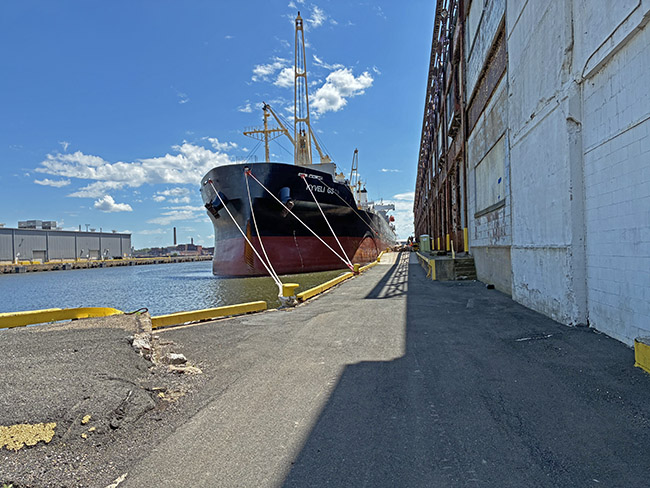
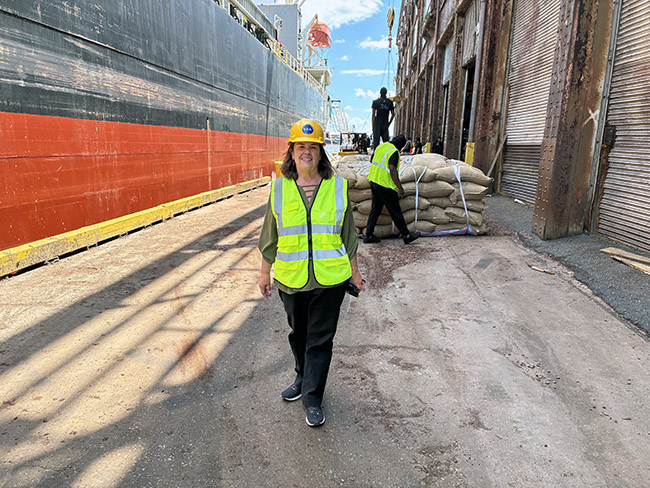
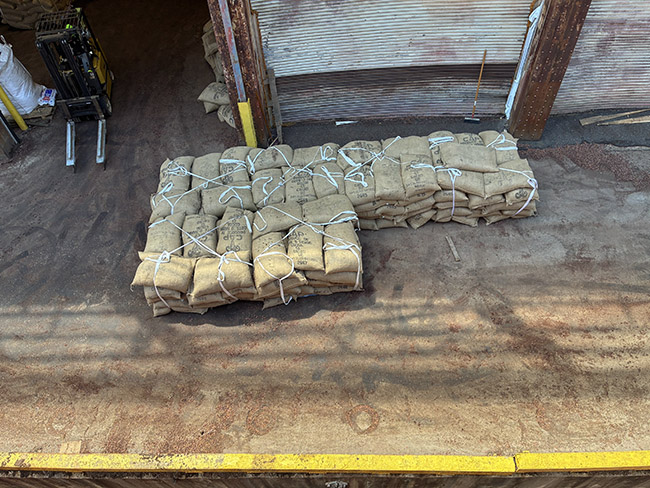
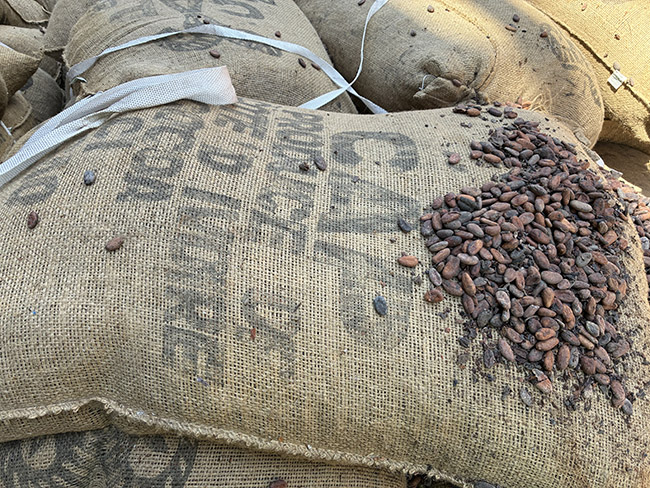
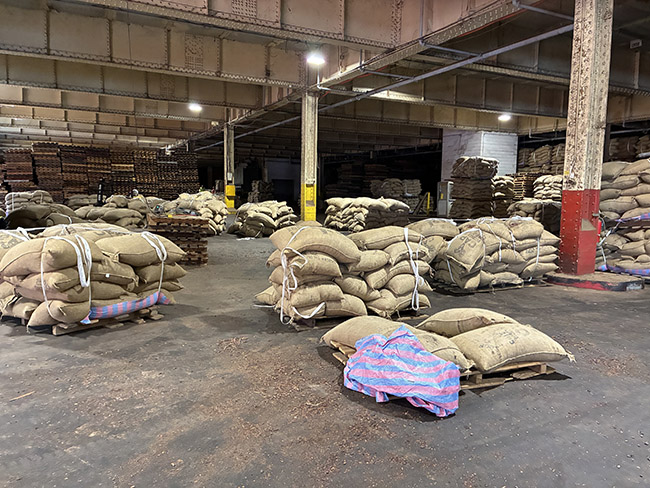
Scenes on Pier 84, Port of Philadelphia. The huge cargo ship, the Kyveli GS, was at dockside.
I’ve written elsewhere about my pending early reader children’s book Pedro’s Delivery, a fictional story based on fact about a Filipino seafarer who escorts cocoa beans from the Ivory Coast to Philadelphia and the difference mariners from often faraway places make in our daily lives.
At age 81 my life has had many blessed chapters, twists and subplots. This blog will celebrate the ones that led to this new book, which comes out in July. Maybe you have had similar unfolding stories. I believe God has breathed life into each subplot.
About 25 years ago I worked with other Lutherans on a long-term flood recovery escapade to help mostly older residents along the banks of the Delaware River recover from the ravages of two tropical storms. That work involved me with seminarians from what was then known as The Lutheran Theological Seminary at Philadelphia (now part of United Lutheran Seminary), as well as volunteers from Trinity Lutheran Church in Lansdale, PA. Volunteering several years along the Delaware was in itself life changing. My wife, Lynn and I subsequently helped out in the aftermath of Katrina in Mississippi.
While working in Bucks County I met another volunteer, the Rev. William Rex, who was pastoring a Lutheran church in nearby Ferndale. Eventually, Bill invited me to serve with him as a shipboard visitor extending hospitality to cargo ship seafarers visiting the Port of Philadelphia.
One ministry leads to another. I became a visitor with Homeland Security credentials affording me access to highly secure terminals in the Port of Philadelphia. That service was as an ambassador for Seamen’s Church Institute of Philadelphia and South Jersey (SCI) for 10 years.
Memories gleaned from relating to thousands of seafarers on hundreds of ships led me to write Pedro’s story. I wanted early readers to know something of how commodities get to their store shelves. I wanted them to know about the seafaring professionals who sacrifice so much to “deliver” for them.
I showed my manuscript to Helene Pierson, the CEO for SCI, a couple of years ago long after I had “retired” from climbing gangways on so many ships, sometimes writing stories about my experiences for SCI when Father Jim Von Dreele was the SCI leader. After reading it to a grandchild, Helene was enthusiastic about the “face” the story would give to many who know little, if anything about the origins of commodities we take for granted when we shop.
She has been a vigorous supporter, helping me with author photos aboard ship in Gloucester City, NJ, early in 2026 and introducing me to Jeff Wheeler, the man who oversees the importing of cocoa beans from West Africa to the Port of Philadelphia, and the distributing from there of bags of beans as far away as Illinois and Wisconsin. In 2025 the Port of Philadelphia imported 5 million bags of cocoa beans, more than received by any other port in the U.S. Jeff himself is a remarkable story. He began as a longshoreman helping to load bags of cocoa beans on railroad cars in the Port. Today he is the chief executive of Dependable Distribution Services, Inc. in Pennsauken, NJ. Jeff has also become an advocate for Pedro’s story. “Many people don’t understand much about the people who work in international trade and what goes on behind the scenes in places like our port,” he says. “This book will really put a face on that work.”
A couple of other twists remain to relate about this Pedro journey.
I had an electronic exchange on Alignable, a sprawling electronic network for entrepreneurs, with Yvonne Kathryn Caputo, an author of adult books published with Ingenium Books of Toronto. Yvonne suggested I submit Pedro’s manuscript to that publishing house. Ingenium acquired the rights to publish the book. Unfortunately, Ingenium closed while the book was in process. Happily, Pedro was picked up by Pink Umbrella Books of San Clemente, CA. Ingenium had hired Pink Umbrella’s owner, Adrienne Quintana, to work with me and illustrator Sandra Jessop to develop the book. Thanks to Yvonne’s suggestion, Pedro’s Delivery will soon come to pass! I am deeply grateful to Adrienne and Sandra for all their hard work!
And special credit goes to John Kahler of Coatesville, PA, my long-time friend, technical specialist, photographer and publicist. He plays a major role in bringing my work to life. John is truly a wizard!
The final special twist in this Pedro Journey belongs to Lynn Roberts Staples, my spouse of nearly 59 years. Without her encouragement and support none of this happens.
Pedro’s main lesson is a simple global perspective I hope children will take to heart as they read. We need each other.

Leave a Comment