
By Mark A. Staples
PHILADELPHIA, PA (Feb. 16, 2026) — It was to be a typical photo shoot in the Port of Philadelphia, the kind a publisher requests of its authors for publicity images taken in a context befitting a future book.
I had written Pedro’s Delivery, an early reader book about the travails of a Filipino seafarer who escorts a cargo ship brimming with bags of cocoa beans from the Ivory Coast to Pennsylvania, where chocolatiers turn the beans into candy bars for store shelves. Many of us don’t think much about the details of such journeys. After 10 years serving as a Homeland Security-certified shipboard visitor to strangers on ships, I wanted children to know more about how seafarers sacrificially serve us. (I volunteered for the venerable Seamen’s Church Institute of Philadelphia and South Jersey all those years.)
Pedro’s Delivery will be the first imprint of Granum Kids, an initiative of Ingenium Books, Toronto, ONT, when it is released in July. We both see this story as a celebration of global partnerships and the basics of trade relationships involving myriad nations. In short, we need each other.
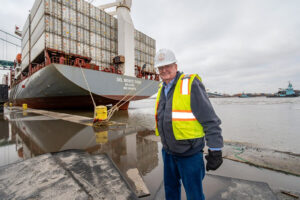
Mark on the dock with Del Monte Rose
I was to visit the Port’s Gloucester City Fruit Terminal and the Del Monte Rose, a ship brimming with containers of bananas brought from Costa Rica and Guatemala. Soon the bananas would hit the region’s store shelves. The assignment was simple enough. My photographer, John Kahler, would take scores of photos of me. Mark with the captain, Mark with an able-bodied seaman from the Philippines – like Pedro in my book of fiction based on fact. Visuals of Mark in the busy Port. It was unusual only because as a career photojournalist and publicist, I am the one frequently taking pictures of others — until now. But simple enough.
Then I looked at the Del Monte Rose’s crew list: Vitaliy Sopin, a Russian and Master (Captain) of the ship. The next highest-ranking officers? Yevgen Ryezanov, Viacheslav Shynkarenko and Dmytro Kravtsov — all Ukrainian.
I felt the axis of my world shifting. With images of war back home daily filling our television screens, what is it like for these men on two sides of a conflict to work together for months at a time? One thing I learned, collaborations between Russian and Ukrainian seafarers aboard today’s cargo ships are not uncommon.
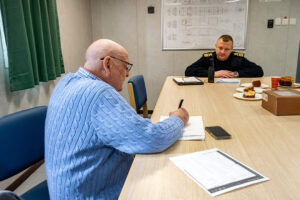
Mark and Master Vitaliy
Master Vitaliy, 39, is a third-generation seafarer from Sochi, Russia. He is a Russian Orthodox believer with a sense of humor that flashes amid his businesslike demeanor. He does not like every aspect of seafaring, particularly the part about being away for four months at a time from his wife, Anastasiio and his children, Ihor, 8, and Juliya, 5. One of the things he relishes about seafaring is the freedom he enjoys at sea compared to life back home. Like many Russians, Vitaliy has relatives in both Russia and Ukraine, the latter of which was once part of the former Union of Soviet Socialist Republics. He also enjoys “seeing the world.” At a relatively tender age he estimates he has tied up at 30 countries.
When Russian and Ukrainian seafarers coexisted at sea as the war first began, tensions were higher than they are now., Vitaliy agrees. “Now in the ship’s daily routine, politics and religious differences are just not talked about except perhaps during some very private conversations. Tomorrow we will leave for Costa Rica and then Guatemala to pick up bananas, and we will be back here in two weeks. That is our focus.”
Chief Officer Yevgen hails from Crimea in the Ukraine. When not on duty, home for Ukrainian seafarers who want to continue their vocation need to live outside of their home country to return to their duty. Those returning home could face conscription, I learn. Most Ukrainians choose to live in Poland or Moldova with their families during home leave. As is the case with his captain, Yevgen has a wife and two young children in his adopted home. He agrees that it is all business between all the nationalities aboard the Del Monte Rose. The crew consists also of Filipinos, several of whom are able-bodied seamen like the author has described in Pedro’s Delivery.
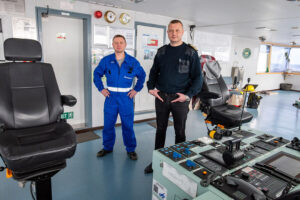
On the bridge
Watching the captain and his first officer relate during a day in port there is a noticeable lack of tension between the ship’s highest-ranking officers. The camaraderie appears genuine and unforced.
Both men share the same view about the war as expressed by Master Vitaliy. “We think the fighting should stop. People should gather around a table and find a solution,” Valeriy says.
Fighting continues back home, but aboard the five-year-old Del Monte Rose it feels like a different world.